Alaska Driver's License Issue Date: Where to Find It and What It Means
Online forms, background checks, and insurance applications often ask for your driver's license issue date. On older licenses it was easy to spot. On the current Alaska REAL ID design, it's abbreviated and placed differently, which trips people up if they haven't seen the new format before.
Table Of Contents
- 1. Where to find the issue date on an old Alaska driver's license
- 2. Where to find ISS on the new Alaska REAL ID license
- 3. Understanding the date fields on your Alaska license
- 4. Why forms ask for the issue date
- 5. Alaska restriction codes (Rest.) explained
- 6. How to renew your Alaska driver's license
- 7. What if you lost your Alaska license?
- 8. Issue dates on driver's licenses in other states
- 9. Using your Alaska REAL ID for travel
- 10. Getting an Alaska license for the first time
- 11. Transferring an out-of-state license to Alaska
- 12. Alaska ID cards for non-drivers
- 13. What the ISS date means for insurance and background checks
- 14. Comparing the Alaska and California license layout
- 15. Common mistakes when using your license issue date
Where to find the issue date on an old Alaska driver's license
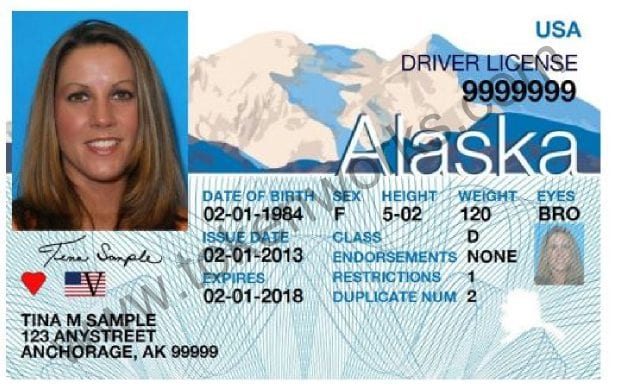
On pre-REAL ID Alaska driver's licenses, the issue date was labeled exactly that: "Issue Date." It appeared next to the photo, below the date of birth field. It was straightforward to find because the label spelled it out in plain text.
Only 1% of California drivers answer all 3 correctly
Think you know the rules? Most licensed drivers miss at least one.
At 60 mph on a dry California freeway, what is the recommended minimum following distance?
Where to find ISS on the new Alaska REAL ID license
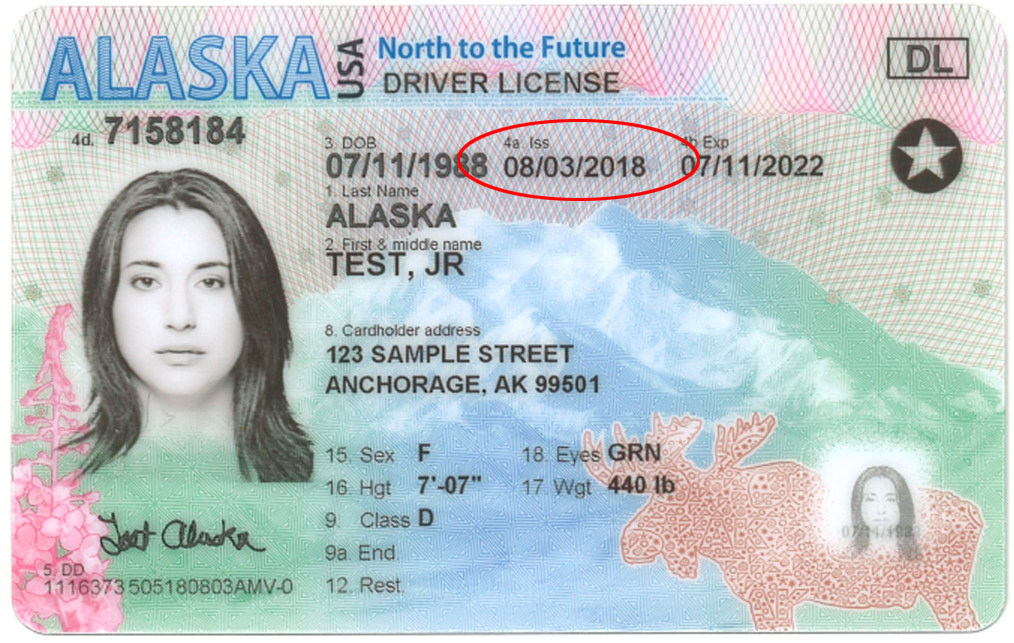
The new Alaska REAL ID design uses the abbreviation ISS for the issue date, placed at the top of the card. ISS stands for "Issue Date": the date your current license was issued, not the date you first got a license.
Preparing for your DMV test?
Download our free iOS app — 1,164+ practice questions in 11 languages, flashcards, and offline study!

In the sample card, ISS shows March 8, 2018. That's the date the physical card was printed and issued. If you renew your license, the ISS date changes to the renewal date. The gold star in the upper right corner of the card confirms it's REAL ID compliant, which means it can be used as ID for domestic flights and federal buildings.
Understanding the date fields on your Alaska license
The new Alaska license design uses three abbreviated date fields that are easy to confuse:
- ISS: Issue date. The date your current license was issued or last renewed.
- DOB: Date of birth. Your birthdate, used to confirm identity and age.
- EXP: Expiration date. The date your license expires. In Alaska, most licenses are valid for 5 years.
When a form asks for your "driver's license issue date," they want ISS. When they ask for your "license expiration date," they want EXP. When they ask for your date of birth, they want DOB. Each is printed separately on the card.
Why forms ask for the issue date
The issue date serves two purposes. First, it tells the person or system verifying your license how recently it was issued, which helps confirm you have a current, valid license rather than an expired one that was renewed years ago. Second, it's a secondary verification point: along with the license number and expiration date: that makes it harder to forge or misrepresent a license.
Common places that ask for your issue date: rental car companies, background check forms, certain insurance applications, alcohol license verification systems, and some federal employment forms.
Alaska restriction codes (Rest.) explained
Below the main fields on your Alaska license, you may see a "Rest." field: short for Restrictions. (Some other states use RSTR for the same thing.) If the field is empty or shows "None," you have an unrestricted license.
Common Alaska restriction codes:
- A: Must wear corrective lenses (glasses or contacts) while driving
- B: Daylight driving only
- C: No freeway/expressway driving
- D: Speed restriction (varies by individual)
- E: No manual transmission vehicles
- F: Outside mirror required
- G: Requires vehicle with automatic transmission
If you see restriction codes on your license and don't know what they mean, the Alaska DMV website lists all codes and their meanings. It's not worth a trip to the DMV just to ask: the list is available online at online.dmv.alaska.gov.
How to renew your Alaska driver's license
Alaska licenses expire every 5 years for most drivers. You can renew online, by mail, or in person at a DMV office, depending on your situation. Online renewal is available for most standard renewals if your information hasn't changed significantly. You cannot renew online if you need to update your photo or if your license has been expired for more than a year.
When you renew, the ISS date on your new card will update to the renewal date. Your license number stays the same.
Alaska allows you to renew up to 180 days before your expiration date without losing any time on the new license. The new expiration date is calculated from the old one, not from the renewal date, so renewing early doesn't shorten your next cycle.
What if you lost your Alaska license?
If your license is lost, stolen, or damaged, you need a replacement. Alaska issues replacement licenses in person at DMV offices or by mail. You'll need to provide your name, address, date of birth, and the last four digits of your SSN. The replacement card will have a new ISS date (the date it was issued) and a new card number, but your license number and expiration date stay the same.
Issue dates on driver's licenses in other states
Every state places the issue date differently and uses different labels. Some use "ISSUED," some use "ISS," some spell it out in full. California uses "ISS" as well, placed on the front of the license near the bottom. If you're looking for the issue date on a license from another state and can't find it, look for ISS, ISSUED, or the date that doesn't match your birthdate or expiration date.
For a comparison of license designs by state, see our driver's license by state guide.
Using your Alaska REAL ID for travel
The gold star on your Alaska REAL ID means it satisfies federal identification requirements. You can use it for:
- Boarding domestic flights within the United States
- Accessing secure federal facilities (courthouses, military bases)
- Entering nuclear power plants and other regulated facilities
A standard (non-REAL ID) Alaska license is still valid for driving and for most state-level purposes, but TSA stopped accepting non-REAL ID licenses for domestic air travel in May 2025. If your license doesn't have the gold star, you'll need a U.S. passport, passport card, or another REAL ID-compliant document to fly domestically.
Getting an Alaska license for the first time
If you've never had a driver's license in any state, Alaska issues a learner's permit first. You must be at least 14 years old to get a permit and must hold it for at least 6 months before applying for a full license. The written knowledge test covers traffic laws, road signs, and safe driving practices based on the Alaska Driver Manual.
To get a license at 16 or 17, you must pass a behind-the-wheel driving test. Alaska has a graduated licensing program, so new drivers under 18 face nighttime driving restrictions and passenger limits for the first period of licensure.
Drivers applying for the first time need to appear in person at an Alaska DMV office. You cannot get your first Alaska license by mail.
Transferring an out-of-state license to Alaska
If you move to Alaska with a valid license from another state, you generally do not need to retake the written or driving test. Alaska accepts valid out-of-state licenses and converts them. You must apply in person, surrender your old license, pass a vision test, and pay the applicable fee.
Commercial driver's licenses (CDLs) from other states transfer to Alaska CDLs through the same process, but Alaska may require a knowledge test for certain endorsements depending on your previous license class.
Alaska ID cards for non-drivers
If you don't drive, Alaska issues state identification cards that carry the same ISS, DOB, and EXP fields as a driver's license. The format is nearly identical, and REAL ID-compliant versions have the same gold star. These are accepted everywhere a driver's license is accepted for identity verification purposes.
ID cards are also issued to minors. A child's card typically shows the parent's or guardian's name on the back for emergency contact purposes.
What the ISS date means for insurance and background checks
When an insurance company, employer, or verification system asks for your ISS date alongside your license number, they're cross-referencing it against their records to confirm the license is current and hasn't been reissued under suspicious circumstances. A license that was reissued recently (new ISS date) may prompt additional questions: for instance, if a license was replaced after a suspension, the new ISS date post-dates the suspension.
For most everyday uses, the ISS date is simply a secondary verification field. You enter it, the system confirms it matches, and you move on. If you can't find it on your license, it's always the ISS field or the date labeled "Issue Date" or "ISSUED."
- ISS: the date this card was printed and issued (or last renewed). This is what most online forms want when they ask for "issue date."
- DOB: your date of birth. Never confuse this with the issue date on forms.
- EXP: the expiration date. Your license is not valid after this date.
- On older Alaska licenses the issue date was spelled out as "Issue Date" rather than abbreviated as ISS.
Comparing the Alaska and California license layout
If you've driven in both Alaska and California, the ISS field appears on both but in slightly different positions. On the California REAL ID license, ISS appears in the lower left area of the card. On the Alaska REAL ID license, it's near the top right, above the expiration date. The abbreviation is the same; the location is not.
Both states follow the American Association of Motor Vehicle Administrators (AAMVA) standard card layout at a high level, but the exact placement of fields varies by state. When filling out a form that asks for issue date on a license from any state, ISS is the field to look for. If you don't see it, look for a date that isn't your birthdate and isn't the expiration date: that's almost always the issue date.
Common mistakes when using your license issue date
- Use the ISS date when forms ask for "issue date" or "date issued"
- Check that the date format matches what the form expects (MM/DD/YYYY vs. YYYY-MM-DD)
- If you have a renewed license, use the ISS date on the current card, not the date of your original license
- Keep a photo of your license on your phone for quick reference on forms
- Update your address within 30 days of moving: Alaska requires this and it affects your license record
- Renew early if your ISS date approaches 5 years: most agencies stop accepting licenses within 6 months of expiry
- Don't enter your DOB when a form asks for the "issue date": they are different dates
- Don't confuse EXP (expiration) with ISS (issue): they are also different fields
- Don't use the issue date from an old, expired license if you have a current one
- Don't leave the issue date field blank assuming it's optional: most background checks require it
- Don't guess the date if you can't read your license: order a replacement rather than entering incorrect information
- Don't assume your SSN matches your license number: they are separate identifiers on Alaska licenses