How to Get a California Driver's License: Step-by-Step Guide (2026)
Getting a California driver's license for the first time involves two separate tests, a waiting period if you're under 18, and a fair amount of paperwork. The process is the same whether you're a teenager getting your first license or an adult who has never held one. Here's exactly what to expect at each step.
Table Of Contents
- 1. Step 1: Make sure you're eligible
- 2. Step 2: Fill out the DL 44 form
- 3. Step 3: Gather your documents
- 4. Step 4: Pay the fee and complete the vision exam
- 5. Step 5: Pass the written knowledge test
- 6. Step 6: Drive with your permit (under 18 only)
- 7. Step 7: Pass the behind-the-wheel driving test
- 8. Step 8: Get your license
- 9. Common questions about appointments and wait times
- 10. What if you fail the written test?
- 11. REAL ID vs. standard California license
- 12. Licenses for undocumented immigrants: AB 60
- 13. After your license arrives: what to check
- 14. Common mistakes that delay getting your license
Step 1: Make sure you're eligible
You must be at least 15 years and 6 months old to apply for a California learner's permit. If you're under 18, you need the signature of a parent or guardian on your application, and they assume legal responsibility for your driving.
Only 1% of California drivers answer all 3 correctly
Think you know the rules? Most licensed drivers miss at least one.
At 60 mph on a dry California freeway, what is the recommended minimum following distance?
Adults 18 and over can apply without parental consent and face a shorter overall process (no mandatory waiting period, fewer required practice hours).
Preparing for your DMV test?
Download our free iOS app — 1,164+ practice questions in 11 languages, flashcards, and offline study!

If you have a valid out-of-state license, California will typically convert it to a California license without requiring the written test, though the behind-the-wheel test may still be required depending on your record.
Step 2: Fill out the DL 44 form
The Driver License or Identification Card Application (DL 44) is the starting point. It cannot be completed online. You can:
- Download and print a copy to fill out at home (English version or Spanish version), then bring it to the DMV
- Pick up a blank form at any California DMV office and fill it out there
- Request one by mail from the DMV by calling 1-800-777-0133
If you're under 18, your parent or guardian must sign the form in front of a DMV employee. Signatures on pre-filled forms are not always accepted without the guardian present.
Step 3: Gather your documents
California requires proof of identity, California residency, and your Social Security Number (if you have one). The DMV uses a point system to verify your identity, and the documents needed depend on what you have available.
Common documents accepted:
- Identity: U.S. birth certificate, U.S. passport, permanent resident card, or foreign passport with valid visa
- SSN: Social Security card, W-2, or SSA-1099 showing your full SSN
- California residency (2 documents required): utility bill, bank statement, lease or rental agreement, school enrollment records, or employer documents with your California address
If you're applying for a REAL ID (which allows you to use your license for domestic flights starting May 2025), you'll need additional documentation. The REAL ID checklist is available at the California DMV website.
Step 4: Pay the fee and complete the vision exam
The application fee for a non-commercial Class C California driver's license is $46. This fee covers the application, the written test, and all three behind-the-wheel test attempts if you need them.
After paying, a DMV employee will test your vision. You need to read at a minimum of 20/40 in at least one eye (with glasses or contacts if you normally wear them). If you don't meet the standard, you'll be referred for a more detailed vision evaluation. Passing the vision exam doesn't mean you won't be required to wear corrective lenses: a restriction code will be added to your license if needed.
Step 5: Pass the written knowledge test
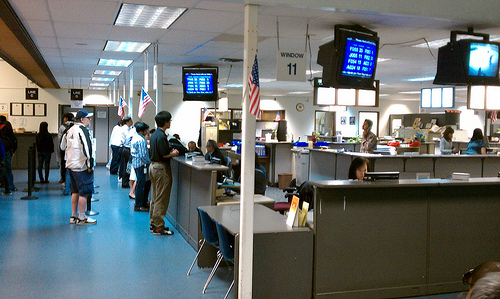
The written test is taken on a computer at the DMV the same day as your application, or you can schedule it separately. The test covers traffic laws, road signs, and safe driving practices: all drawn from the California Driver Handbook.
Drivers under 18 answer 46 questions and must get at least 38 correct (83%). Drivers 18 and over answer 36 questions and must get at least 30 correct (83%). You get three attempts before you must repay the application fee.
The test is available in 36 languages at California DMV offices, including Spanish, Chinese, Vietnamese, Korean, Arabic, Armenian, Hindi, and more. Our free California DMV practice tests mirror the real exam format and are available in 13 languages: working through them before your appointment significantly improves your pass rate.
Step 6: Drive with your permit (under 18 only)
Once you pass the written test, you receive a provisional learner's permit. You can start driving immediately with a licensed driver aged 25 or older in the front seat.
If you're under 18, California requires you to hold the permit for at least 6 months before you can take the behind-the-wheel test. During those 6 months, you must log a minimum of 50 hours of supervised driving practice, of which at least 10 hours must be at night. Your parent or guardian signs off on the driving log, and you bring it to your driving test appointment.
Drivers 18 and over can schedule the behind-the-wheel test as soon as they pass the written test. There is no mandatory waiting period and no minimum practice hours required by law (though practice is strongly recommended).
Step 7: Pass the behind-the-wheel driving test
The driving test is by appointment only at DMV field offices. It runs about 15 to 20 minutes and includes a pre-drive vehicle safety check followed by a scored drive. The examiner uses a score sheet: you start with 100 points, lose one per error, and fail at 15 errors. Critical errors (running a red light, causing a near-collision) end the test immediately.
You must provide your own vehicle. It must be registered, insured, and pass the examiner's safety inspection before the test starts. Bring your permit, proof of insurance, and a licensed driver who can drive the car home if you don't pass.
Our pre-drive checklist guide covers all 15 items the examiner inspects. Our behind-the-wheel test guide covers the scored maneuvers, scoring system, and common fail reasons.
Step 8: Get your license
If you pass the driving test, the DMV takes your photo and issues a temporary paper license on the spot. This is a valid license in California. Your permanent plastic license card arrives by mail within 3 to 4 weeks at the address on your application.
If there are any issues with your documentation or if additional background checks are needed (common with certain visa types or international drivers), processing can take longer.
Common questions about appointments and wait times
Walk-in appointments are available at some DMV offices but waits can be several hours. Making an online appointment at dmv.ca.gov or by calling 1-800-777-0133 saves significant time. Major metro offices in Los Angeles and the Bay Area tend to book out 2 to 4 weeks. Smaller offices outside metro areas often have same-week availability.
If you need your license quickly (for employment, for example), it's worth checking multiple office locations. The written test appointment and the behind-the-wheel test appointment are separate. Some people take the written test at a nearby office and do the behind-the-wheel test at a less busy office later.
What if you fail the written test?
Your application fee covers three written test attempts. You can retake the test the same day if time and slots allow, or schedule for another day at no extra cost. After three fails, you must reapply and pay the fee again before you can test again.
Failing once doesn't mean you have a gap in knowledge: most people who fail did so on a handful of specific questions. Review the California Driver Handbook, focus on road signs and right-of-way rules (which trip up the most people), and work through practice tests before your next attempt. Our free California DMV practice tests match the actual question format and cover every topic in the handbook.
REAL ID vs. standard California license
When you apply for your first California license, you'll be asked whether you want a REAL ID-compliant card or a standard license. Both let you drive. The difference is what you can use them for at the federal level.
A REAL ID card (marked with a gold bear and star in California) can be used to board domestic flights and enter federal facilities. A standard license cannot be used for those purposes starting May 2025, when the TSA stopped accepting non-REAL ID licenses.
To get a REAL ID, you need to bring additional documentation proving your identity and lawful status. The California DMV's REAL ID checklist is the authoritative source: check it before your appointment. The most common additional documents needed are a U.S. passport or birth certificate, your Social Security card, and two California residency documents.
- DMV knowledge test appointments at busy offices book out 2 to 4 weeks in advance. Schedule first, then study.
- The test is available in Spanish and 30+ other languages: select your language when booking your appointment.
- You get 3 attempts at the knowledge test included in your $46 fee. After that, you pay again.
- Schedule your appointment at the DMV appointment portal.
Licenses for undocumented immigrants: AB 60
California issues driver's licenses to undocumented immigrants under AB 60, which took effect in January 2015. These licenses are identical in function to standard California driver's licenses for driving purposes. They include a mark on the front indicating they are not accepted for federal purposes (no flights, no federal buildings), but they are valid California driving credentials.
The application process is the same: DL 44 form, vision exam, written test, and behind-the-wheel test. The documentation requirements differ slightly: the DMV accepts a foreign birth certificate or passport in place of a U.S. identity document.
After your license arrives: what to check
When your permanent plastic license arrives by mail, check these things immediately:
- Your name spelling and date of birth are correct
- The address matches where you wanted it sent
- The restriction codes (if any) match what the DMV discussed with you
- The REAL ID star is present if you applied for a REAL ID license
If anything is wrong, contact the DMV within a few weeks to request a corrected card. Errors on a driver's license are uncommon but do happen, and catching them early is easier than dealing with them at a traffic stop or airport security later.
The California knowledge test is available in over 30 languages at every DMV office. If you're studying with family members who prefer Arabic or Punjabi, they can use the Arabic DMV Simulator Test or the Punjabi DMV Simulator Test: both are 46 questions in the actual exam format and free to take.
Common mistakes that delay getting your license
- Bring originals, not copies, of every required document to your DMV appointment
- Study the California Driver Handbook front to back: roughly 30% of test questions come from sections most people skip
- Schedule your appointment online before arriving at the DMV to avoid a 2 to 4 hour wait
- Track every practice hour on the DL 290 form from day one if you're under 18
- Practice parallel parking and three-point turns specifically: these are common errors in the driving test
- Inspect the car the night before the driving test, not in the parking lot
- Don't drive alone with only a learner's permit: a licensed adult 25 or older must be in the passenger seat
- Don't assume an out-of-state license converts automatically: California may still require a written test
- Don't bring a vehicle to the driving test without functioning turn signals, brake lights, and a clear windshield
- Don't schedule the driving test before logging all required practice hours
- Don't let your permit expire: you'll have to start the process over including paying the fee again
- Don't skip the DL 44 form: the DMV cannot start your application without it