Driving Performance Evaluation Score Sheet
TL;DR: The Driving Performance Evaluation (DPE) score sheet is the form (DL-955) a California DMV examiner uses to score your behind-the-wheel driving test. You can fail three ways: more than 3 mistakes in the pre-drive vehicle check, any single critical driving error, or more than 15 errors on the scoring maneuvers (turns, lane changes, stops). This guide walks every section of the DL-955, what each examiner notation means, the most common failures, and how to retake the test if you do not pass on the first try.
Table Of Contents
- 1. What is the Driving Performance Evaluation score sheet?
- 2. The three ways to fail the behind-the-wheel test
- 3. Scoring maneuvers: the 15-error limit
- 4. The full DPE scoring formula
- 5. What to do and avoid on test day
- 6. What examiners watch for beyond the rubric
- 7. Most common reasons people fail the DPE
- 8. What to bring to your behind-the-wheel test
- 9. What happens if you fail: retakes and fees
- 10. DPE vs CDL skills test (commercial drivers)
- 11. What happens after you pass
What is the Driving Performance Evaluation score sheet?
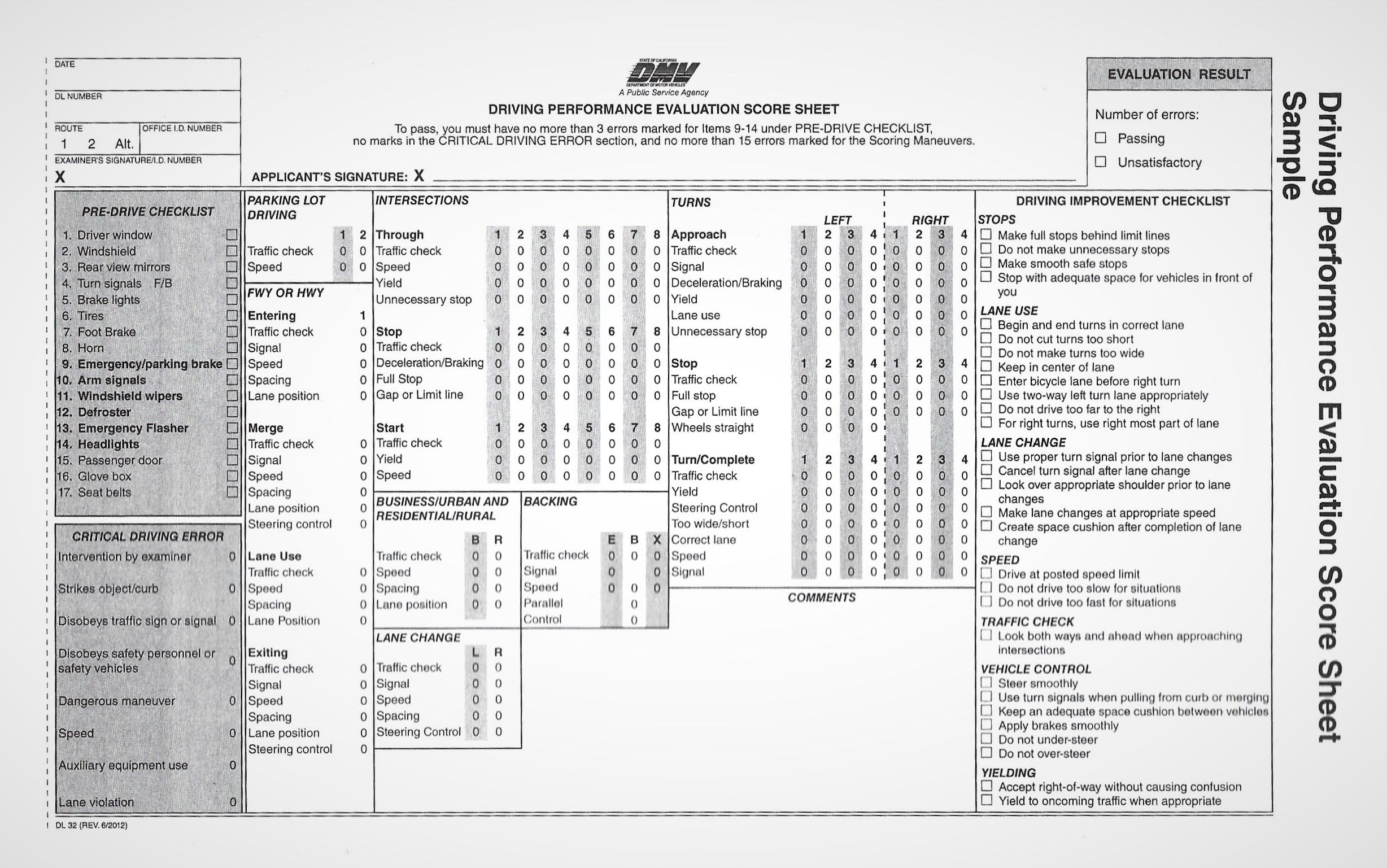
The Driving Performance Evaluation (DPE) is the formal California DMV behind-the-wheel test. The examiner records your performance on form DL-955, the "DPE Score Sheet." Every error, missed signal, and critical mistake is marked on this single double-sided page. At the end of the test, the examiner totals the marks and tells you immediately whether you passed.
Most licensed drivers fail at least 2 of these — can you pass all 3?
These are the questions the DMV doesn't advertise.
What is the exact demerit threshold that fails you on the California behind-the-wheel test?
The three ways to fail the behind-the-wheel test
Failing the DPE comes from one (or more) of three places on the form:
Preparing for your DMV test?
Download our free iOS app — 1,164+ practice questions in 11 languages, flashcards, and offline study!

| # | Section | Threshold to fail |
|---|---|---|
| 1 | Pre-drive checklist (items 9,14, "Must Demonstrate") | More than 3 errors |
| 2 | Critical Driving Errors | Any single mark is automatic fail |
| 3 | Scoring Maneuvers (the actual drive) | More than 15 errors total |
Unlike pre-drive items or scoring maneuvers, a single critical-error mark ends the test on the spot. The examiner typically drives the car back to the office, and you reschedule. There is no "one chance": critical errors are zero-tolerance.
PRE-DRIVING CHECKLIST
Before you start driving, the examiner asks you to identify or operate 17 specific items on the vehicle. Items 9,14 are the "Must Demonstrate" items: for those, max 3 errors before automatic failure.
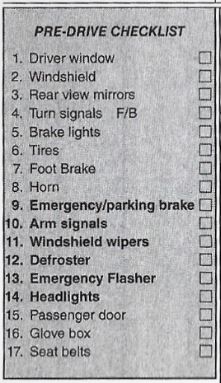
| # | Item | What examiner expects |
|---|---|---|
| 1 | Driver window | Operate it up and down |
| 2 | Windshield | Clear, no damage in driver line of sight |
| 3 | Rear-view mirrors | Identify all 3 (interior + 2 side); adjust them |
| 4 | Turn signals | Activate left + right + show timing knob |
| 5 | Brake lights | Demonstrate (examiner walks behind) |
| 6 | Tires | Identify; condition acceptable |
| 7 | Foot brake | Pump it; show working pressure |
| 8 | Horn | Press once |
| 9 | Emergency / parking brake | Engage and release; explain its purpose |
| 10 | Arm signals | Demonstrate left, right, and slow/stop |
| 11 | Windshield wipers | Operate on low + high speed |
| 12 | Defroster | Identify front (and rear if equipped) |
| 13 | Emergency flashers | Activate the hazard lights |
| 14 | Headlights | Operate low + high beam |
| 15 | Passenger door | Lock / unlock |
| 16 | Glove box | Open + close |
| 17 | Seat belts | Buckle yours; identify passenger belt |
Item 10 (arm signals) is the most-failed pre-drive item. The DMV expects: left arm straight out = left turn; left arm bent up at 90° = right turn; left arm bent down at 90° = slow or stop. Even if you never use these on the road, the examiner expects you to demonstrate all three clearly.
CRITICAL DRIVING ERRORS
One mark in this section and the test ends. The DL-955 lists nine critical errors:
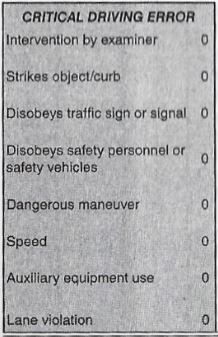
| # | Critical error | What this looks like in practice |
|---|---|---|
| 1 | Intervention by examiner | Examiner grabs the wheel, hits the brake, or verbally directs you to avoid a hazard |
| 2 | Strikes object / curb | Hitting the curb during parallel parking, scraping a cone, brushing a parked car |
| 3 | Disobeys traffic sign or signal | Rolling stop at a stop sign (no full 3-second halt), running a red light, ignoring a yield sign |
| 4 | Disobeys safety personnel or safety vehicles | Not yielding to emergency vehicles, ignoring a crossing guard, not stopping for a school bus with red flashers |
| 5 | Dangerous maneuver | Sudden lane change, U-turn where prohibited, cutting off another vehicle |
| 6 | Speed | More than ~5 mph over the limit, or driving so slow it disrupts traffic |
| 7 | Auxiliary equipment use | Failing to use mirrors or signals at moments where they are essential to safety |
| 8 | Lane violation | Crossing a double-yellow, driving in a bike lane, drifting across lane lines |
| 9 | Driver behavior | Argumentative, aggressive, refusing examiner instructions, using a phone |
Scoring maneuvers: the 15-error limit
The bulk of the test is the scoring-maneuvers section. The examiner directs you through a 20-minute route that includes turns, lane changes, stops, parallel parking (or curb parking), residential and arterial driving. Each maneuver is broken into observation, signaling, control, and judgment points. The examiner can mark up to 15 total errors before you fail this section.
Errors fall into these categories:
| Category | What examiner marks for |
|---|---|
| Observation | Did not check mirror, blind spot, or head-turn before changing lanes or pulling away from curb |
| Signal | Forgot turn signal, signaled too late, left signal on after turn complete |
| Steering | Hand position wrong (one-handed when both expected), wide on a turn, drifted in lane |
| Speed | More than 5 mph over limit, hesitating in normal traffic flow, school-zone speeding |
| Lane usage | Drifted from lane, did not use bike-lane gap for right turns, wrong lane for turn |
| Direction | Wide turn, cut a corner, hit the curb during turn |
| Following distance | "Three-second rule" not maintained; tailgating |
| Stopping | Rolling, abrupt, past the limit line, did not signal stop |
| Parallel parking | More than 18 inches from curb, over the curb, multiple attempts |
| Backing | Did not look out the back window; one-handed steering while reversing |
The full DPE scoring formula
The examiner does not need to articulate scoring math during the test, but if you want to know exactly how the pass/fail decision is calculated:
- Pre-drive items 9,14: count marks. If more than 3, automatic fail.
- Critical Driving Errors: any single mark → fail, regardless of other sections.
- Scoring Maneuvers: total all error marks. If more than 15, fail.
- If none of the above triggers, you pass: even with up to 15 errors and 3 pre-drive errors on file.
Three errors on pre-drive items 9,14 still passes pre-drive (the limit is "more than 3"). The threshold is real but not perfection. Same with the scoring maneuvers: 15 errors is the cap, not a benchmark: most successful drivers test in the 0,6 error range.
What to do and avoid on test day
- Come to a complete 3-second stop at every STOP sign: wheels fully stopped, not slowing to a crawl
- Check your mirror and then physically turn your head to check the blind spot before every lane change
- Keep both hands on the wheel at 9 and 3 o'clock throughout the entire drive
- Signal every turn and lane change at least 100 feet in advance, then cancel after completing the move
- Practice the arm signals (left, right, slow/stop) out loud the night before: item 10 is the most-failed pre-drive item
- Brake and accelerate gradually: smooth inputs signal control; abrupt inputs draw marks
- Don't roll through a stop sign even slightly: any movement during the stop counts as a rolling stop and triggers an automatic fail
- Don't use mirrors alone for a lane change: the blind spot head-turn is a separate expected action
- Don't exceed the speed limit by more than 5 mph: that is a critical error and the test ends immediately
- Don't touch the curb during parallel parking: striking any object is an automatic fail
- Don't adjust your mirrors or seat once the pre-drive check begins: do all adjustments before the examiner starts the checklist
- Don't argue with or ignore the examiner's instructions: "Driver behavior" is its own critical error category
What examiners watch for beyond the rubric
Examiners are trained on the DL-955 rubric, but in practice they also weight a handful of behaviors that signal a safe versus unsafe driver:
- Mirror checks before lane changes. A quick mirror + over-the-shoulder glance is essentially the expectation; missing it is one of the most-marked observation errors.
- Hands at 9 and 3 (or 10 and 2). Hands on the wheel, both of them, almost always: except when shifting or using the signal.
- Smoothness. Braking, accelerating, and steering should all be gradual. Abrupt anything draws a mark.
- Yielding even when not required. Yielding to a pedestrian at an unmarked crosswalk, or to a cyclist in a shared lane, signals defensive driving even when the traffic code does not technically require it.
- Voice volume and confidence on the pre-drive. Mumbling through arm signals or hesitating on the headlight controls draws a mark even if the answer is correct.
Most common reasons people fail the DPE
Across thousands of California behind-the-wheel tests, these are the top failure reasons:
- Rolling stops at stop signs. Counts as "Disobeys traffic sign": automatic fail. Come to a full halt of at least 2,3 seconds, even if no traffic is around.
- Failing to check mirrors and blind spot before a lane change. Marked under Observation, repeated often, easily over the 15-error limit.
- Speeding more than 5 mph over. Counts as critical Speed error: automatic fail.
- Hitting the curb on parallel parking. Strikes object/curb: automatic fail.
- Forgetting turn signals on the final part of the route. Tiredness sets in; examiner is watching.
- Hesitating at a green light. Marked as "auxiliary equipment use" or speed (too slow).
For a longer breakdown of these failures with practice exercises, see our California driving test tips and behind-the-wheel mistakes guides.
What to bring to your behind-the-wheel test
Show up to your appointment with every item on this list. Missing any one means rescheduling: and your test slot is gone for the day:
- Your valid California instruction permit
- Proof of insurance for the vehicle you are testing in
- Current vehicle registration
- For drivers under 18: signed practice log (50 hours; 10 at night), and form OL-237A (six-hour driver training certificate)
- Method of payment for the application fee, if not already paid
- Glasses or contacts if listed on your permit's RSTR field
What happens if you fail: retakes and fees
If you do not pass, the examiner explains which section triggered the failure. You then schedule a retest:
- Wait at least 2 weeks between attempts. The DMV system enforces this: you cannot schedule sooner.
- You have 3 attempts per application. The application fee ($46 as of 2026) covers all three.
- If you fail all 3 attempts, you must re-apply (new $46 fee) and re-take the written knowledge test before scheduling a fourth behind-the-wheel attempt.
- There is no per-retest fee within an application. Older references to a "$7 retest charge" are outdated; the current rule is one fee per application.
DPE vs CDL skills test (commercial drivers)
The DL-955 DPE is for non-commercial (Class C) and provisional licenses. Commercial drivers take a different rubric: the CDL skills test, which has three separate components (pre-trip inspection, basic control skills, and on-road driving). For full CDL test details, see our California truck driver CDL guide.
Motorcycle riders take yet another test based on the Motorcycle Safety Foundation rubric: see our Class M motorcycle license guide.
What happens after you pass
Pass the DPE and the examiner hands you a temporary paper license valid for 90 days. Your plastic Class C license arrives by mail within 4,6 weeks. If you are under 18, the new license is a provisional license with restrictions: no passengers under 20 unless a licensed adult 25+ is present, and no driving 11 p.m.,5 a.m. unaccompanied. See our California teen driver guide for the full provisional rules.
For a visual tour of every state's driver license design: including the issue date label and abbreviations: see our full guide.
See our driver's license guide by state for the ISS label and field layout on every US license.