How to Find the Issue Date on Your California Driver's License (2026)
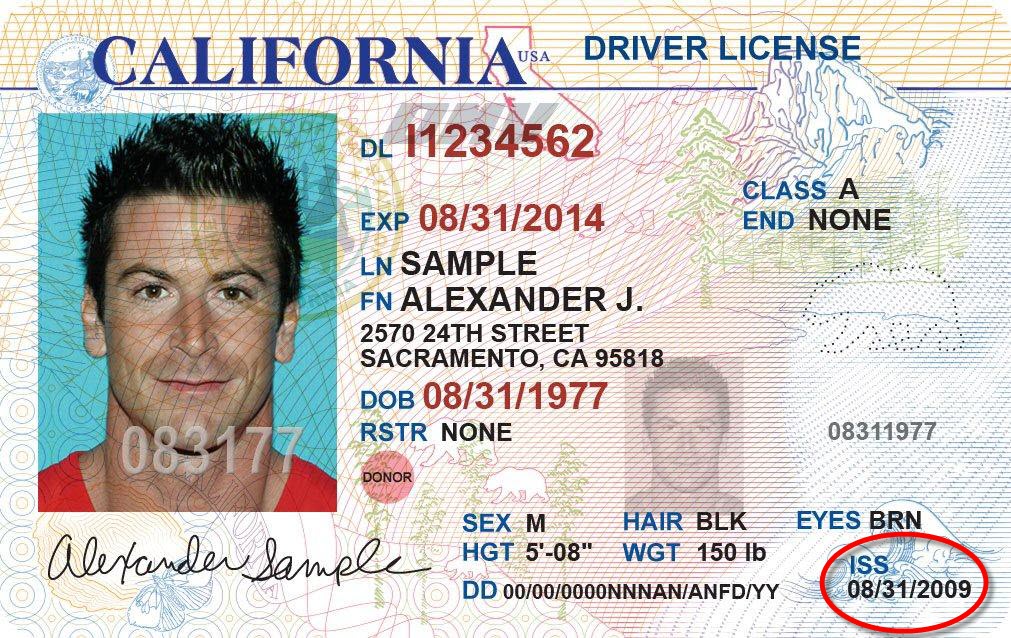
TL;DR: Your California driver's license issue date is labeled "ISS" on the front of the card, in the lower-right section near the expiration date (EXP). It marks the day your current card was printed: not the day you first became a licensed California driver. The original first-licensed date is not printed on the plastic at all; you have to order a full driving record from the California DMV to recover it. This guide decodes every abbreviation on the card, explains the original-issue-date trap that catches people applying for insurance discounts or background checks, and links to step-by-step state-specific guides for the other states we have already covered.
Table Of Contents
- 1. What does ISS mean on a driver’s license?
- 2. Where the issue date appears on a California driver's license
- 3. Every abbreviation on a California driver's license, decoded
- 4. What is DD on California Driver's License?
- 5. What does RSTR stand for?
- 6. Why the issue date actually matters
- 7. How to find your original first-licensed date
- 8. California driver license number format
- 9. Reading the back of a California driver's license
- 10. REAL ID and the gold star
- 11. California driver license classes
- 12. Issue date label on other states' licenses
- 13. Expiration vs issue date: how to calculate your next renewal
- 14. Common mistakes when reading a California license
What does ISS mean on a driver’s license?
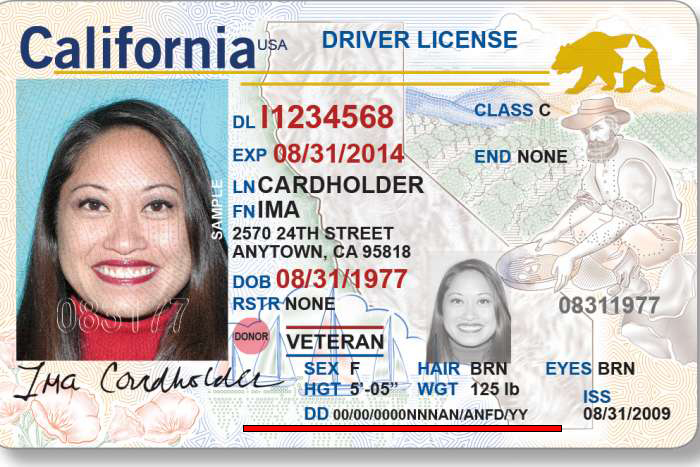
ISS stands for “issue date”: the date your current driver’s license or ID card was issued (printed). On a California driver’s license, ISS appears in the lower-right of the card, next to the expiration date (EXP). It is the start date of your current card, not necessarily the first time you were ever licensed.
Where the issue date appears on a California driver's license
California prints the issue date in the lower-right section of the card, labeled simply ISS (short for "Issue Date"). On a sample California Class C license you might see ISS 09/30/2010. That is the date the California DMV printed the physical card you are holding. It is not necessarily the day you first received a driver's license in California: see the "original issue date" section below.
Preparing for your DMV test?
Download our free iOS app — 1,164+ practice questions in 11 languages, flashcards, and offline study!

Only 1% of California drivers can answer all 3 of these
Think you know your license? Most people are wrong on at least one.
At what age does a California driver license shift from a 5-year to a 2-year renewal cycle?
Every abbreviation on a California driver's license, decoded
California licenses use the AAMVA-standard set of two- and three-letter labels. Most appear on the front; a few extras encode in the back-of-card barcode. Here is the complete list you will see on the printed face:
| Label | Meaning | Where it appears |
|---|---|---|
| DLN (or just the long number at the top) | Driver License Number: letter + 7 digits, permanent to you | Top-center, large bold |
| DOB | Date of Birth (MM/DD/YYYY) | Left of photo |
| EXP | Expiration date of this card | Lower-right, near ISS |
| ISS | Issue date of the current card | Lower-right, near EXP |
| CLASS | Vehicle class authorized (C, M1, M2, A, B, DJ) | Below EXP |
| END | Endorsements (mostly for commercial drivers) | Below CLASS |
| RSTR | Restrictions (corrective lenses, mirror, etc.) | Below END |
| DD | Document Discriminator: unique to that one printed card | Below RSTR |
| SEX | M / F / X | Right of DOB |
| HGT | Height (feet/inches) | Right of SEX |
| WGT | Weight (pounds) | Right of HGT |
| EYES | Eye color abbreviation (BLU, BRN, GRN, HZL, BLK) | Right of WGT |
| HAIR | Hair color abbreviation (BLK, BRN, BLD, GRY, RED) | Right of EYES |
What is DD on California Driver's License?
DD stands for Document Discriminator. It is a unique serial number the California DMV assigns to that specific piece of plastic. The DD changes every time you renew or replace your license (lost, stolen, address update). Your DLN: the driver license number at the top of the card: stays the same for life.
Banks, rental car companies, and TSA agents sometimes scan or check the DD to verify that the card in front of them was actually issued by the DMV and has not been altered. The 13,14 character DD is also encoded inside the PDF417 barcode on the back, which is how grocery store self-checkout machines verify your age.
What does RSTR stand for?
RSTR stands for Restrictions: codes that limit how, when, or in what vehicle you can drive. You probably already know yours if you have any, but if you have lost track or you are reading someone else's license, the most common California restriction codes are:
| Code | Restriction |
|---|---|
| 1 | Corrective lenses (glasses or contacts required) |
| 2 | Mechanical aid (e.g., special hand or foot control) |
| 3 | Prosthetic aid |
| 4 | Automatic transmission only |
| 5 | Outside mirror |
| 6 | Daylight driving only |
| 7 | Limited speed |
| 8 | Geographic restriction (driving only in a defined area) |
| 46 | Provisional license: passenger and night driving limits (CVC §12814.6) |
Why the issue date actually matters
"Where is the ISS on my license?" is usually the surface question. The deeper reason people search for it falls into three buckets:
Insurance discounts and "years licensed"
Most car insurance carriers offer a sliding discount based on how many years you have held a driver's license. Some agents will accept the ISS date on your current card as proof of "years licensed": but the better discount comes from showing the date you were first licensed, which is not on your card.
Employment background checks
Employers running an employment driving record check (often through HireRight or Sterling) see a 3-year, 7-year, or complete driving history. The ISS on the card alone does not tell them when you started driving: they pull that from the DMV directly.
Immigration and naturalization applications
USCIS sometimes requests proof of continuous U.S. residence during the green-card or naturalization process. A California license's ISS date is one piece of that puzzle; the complete driving record is a much stronger artifact.
This is the most important thing to know about your California ISS date: it resets every time you renew or replace the card. A driver who has been licensed since 1998 but renewed last year sees ISS = 2024 on the card. The 1998 date lives in the DMV's database, not on the plastic. If you need the original date for an insurance discount, background check, or immigration application, you have to request your driving record: see the next section.
How to find your original first-licensed date
To recover the date you were first licensed in California, request your full driving record from the California DMV. There are two ways:
- Online via myDMV: Free for the first download per year if you have a myDMV account. Provides a 3-year history; ask for the "lifetime" or "complete" record for the original ISS. The download is a PDF.
- By mail: Submit form INF 1125 (Request for Your Own Driver's License Information). Fee is $5 for a 3-year H6 abstract, $5 for a lifetime H6. Mail to: DMV Headquarters, P.O. Box 944247, Sacramento CA 94244-2470.
The online myDMV download takes about 5 minutes after you finish account setup. The first one each year is free. You will need your DLN, last 4 of your Social Security number, and access to the email tied to your myDMV account.
California driver license number format
California driver license numbers follow a fixed format under California Vehicle Code §12810 administrative rules: one letter followed by seven digits. For example, L1234567. The letter and digits are assigned sequentially as each license is created: there is no embedded date or geographic information in the number itself. The DLN stays with you for life, even through renewals, replacements, and name changes.
The numbering scheme and required information on a California license are specified by CVC §12810. The same code section authorizes the DMV to design the card layout, choose which abbreviations to use, and update the format to comply with federal REAL ID standards.
Reading the back of a California driver's license
The back of a California license carries a magnetic stripe and a PDF417 2D barcode. Both encode an expanded set of fields a bartender or TSA agent can scan to verify the card:
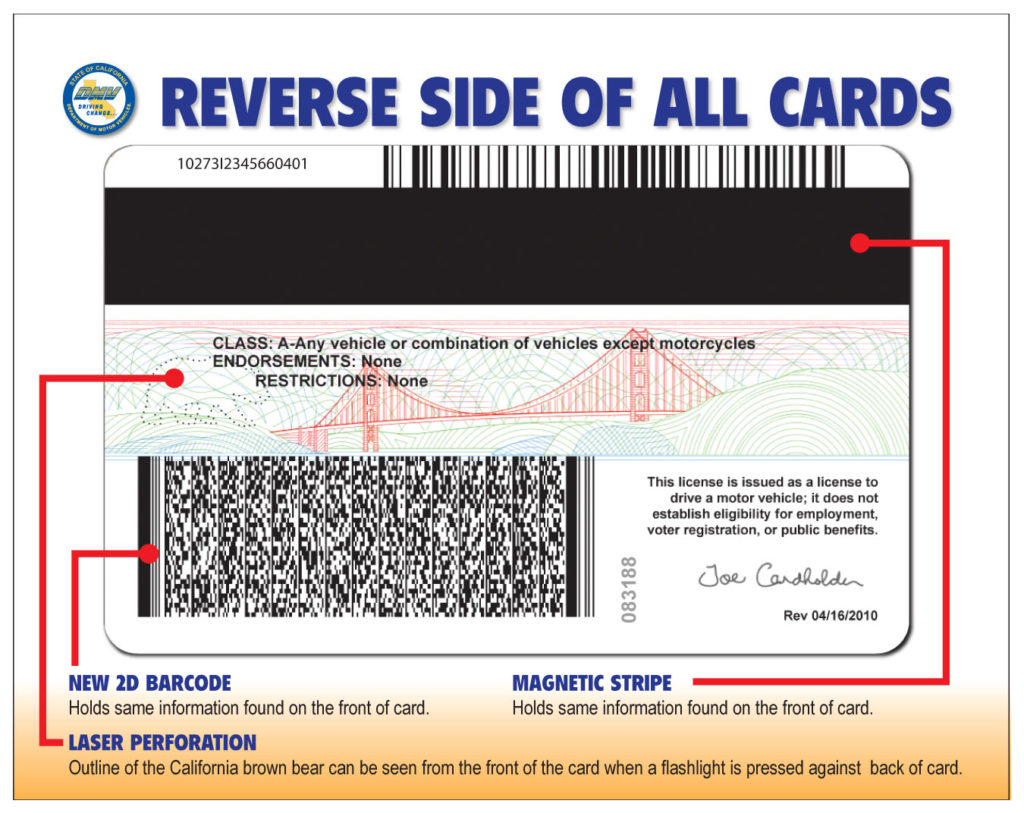
- DCS: Customer Family Name (your last name)
- DAC: Customer First Name
- DBD: Document Issue Date (same as ISS on the front)
- DBA: Document Expiration Date
- DBB: Date of Birth
- DAQ: Customer ID Number (your DLN)
- DCF: Document Discriminator (the DD)
- DDE / DDF / DDG: flags for compliance, REAL ID, and audit history
REAL ID and the gold star
A small gold-star emblem in the upper-right corner of a California license means the card is REAL ID compliant. From May 7, 2025 onward, you need a REAL ID card (or another federally accepted ID like a U.S. passport) to board a domestic flight or enter a federal building. The deadline has already passed, so if your card does not have the gold star and you fly even occasionally, plan an upgrade.
For the full upgrade checklist: exactly which documents the DMV will accept for identity, residency, and Social Security verification: see our California REAL ID checklist.
California driver license classes
The "CLASS" field on the front of the card tells you what you are licensed to drive. The most common are:
| Class | What it covers |
|---|---|
| C | Standard non-commercial license: most cars, light trucks, vans, motorhomes |
| M1 | All motorcycles, motor-driven cycles, and motorized scooters |
| M2 | Mopeds and motorized bicycles only |
| A | Commercial: combination vehicles over 26,000 lbs with trailers over 10,000 lbs |
| B | Commercial: single vehicles over 26,000 lbs (trucks, buses) |
| DJ | Junior: provisional license held by drivers under 18 |
For full details on each class, see our Class M motorcycle license guide and California CDL guide.
Issue date label on other states' licenses
Not every state uses "ISS." About two-thirds use the same AAMVA short code, but several spell it out differently: and a few hide the issue date in the barcode rather than printing it on the front. We have published detailed state-specific guides for the most-searched ones; each link below opens the full breakdown:
| State | Label | Notes |
|---|---|---|
| California | ISS | Lower-right, next to EXP (you are here) |
| Texas | ISS | Under DOB, next to EXP |
| Florida | ISS | Lower-center; original issue date not printed |
| New York | Issued | Spelled out instead of "ISS" |
| Pennsylvania | ISS | Under photo, above EXP |
| Ohio | 4AISS | AAMVA-numbered label, same field as ISS |
| Georgia | DBD | Hidden in the barcode: not on the front |
| Michigan | ISS | Near EXP, lower portion |
| Arizona | ISS | Bottom-right corner |
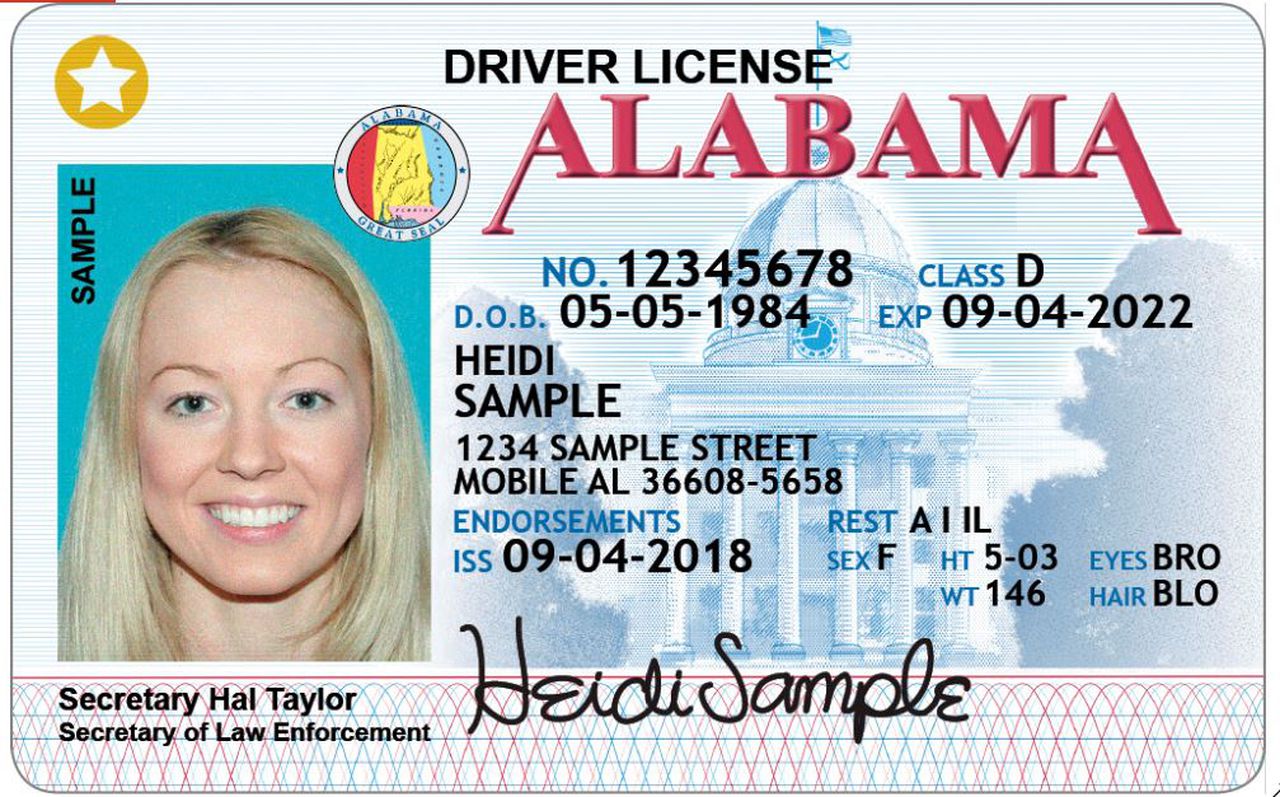
| Alabama | ISS | Center, next to photo |
| Alaska | ISS | Near DOB on older cards; relabeled on REAL ID-era cards |
Expiration vs issue date: how to calculate your next renewal
A standard California Class C license is valid for 5 years. If your ISS is 09/30/2024, your EXP will be about 09/30/2029 (the exact date is usually your birthday in the renewal year). If you are 70 or older, you renew at the same interval but in person: see our California senior driver license guide.
Common mistakes when reading a California license
These are the most common misreadings:
- Confusing ISS with DD. The ISS is a date; the DD is a long alphanumeric serial number. They sit next to each other on the card.
- Treating ISS as "first licensed" date. It is not. The current ISS resets at every renewal: see the original-issue-date section.
- Reading SEX as a typo. Some older drivers expect "MAR" or "MARRIED." California only prints M / F / X.
- Mistaking the DLN suffix for the DD. Your DLN is a fixed letter + 7 digits; the DD is much longer (13,14 chars).
- Reading the back-of-card date as the issue date. The PDF417 barcode encodes the same ISS as the front (field DBD). They should match exactly: if they do not, the card has been tampered with.
For a visual tour of every state's driver license design, see our full guide.
Frequently Asked Questions
What does ISS mean on a driver’s license?
ISS is the abbreviation for “issue date”: the date your current driver’s license or ID card was issued. On a California license it is printed in the lower-right corner, next to the expiration (EXP) date.
What does the ISS date mean on an ID card?
On an ID card, the ISS date is the issue date: the day that specific card was produced. It is not the date you first applied for an ID; it resets each time a new card is issued, such as after a renewal or replacement.